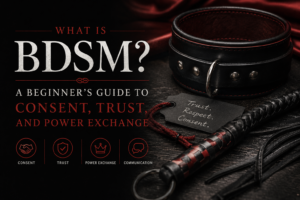
What Is BDSM? A Beginner’s Guide to Consent, Trust, and Power Exchange
By The Curious Commons Editorial – July 4, 2026
For many people, the first impression of BDSM comes from movies, television, or social media. Unfortunately, those portrayals often emphasize shock value over reality, creating misconceptions about what BDSM is and how healthy BDSM relationships actually function.
In reality, BDSM is built on communication, informed consent, trust, and mutual respect. While it can include a wide variety of activities and relationship styles, the foundation remains the same: every participant willingly agrees to what takes place, understands the boundaries involved, and has the ability to stop at any time.
Understanding these principles is the first step toward separating fact from fiction.
What Does BDSM Mean?
The term BDSM is an acronym representing several related practices and relationship dynamics.
- Bondage & Discipline (B/D) involves restraint, structure, and agreed-upon rules or protocols.
- Dominance & Submission (D/s) focuses on the consensual exchange of authority between partners.
- Sadism & Masochism (S/M) refers to giving or receiving physical or emotional sensations that all participants have freely agreed to experience.
Not everyone who identifies with BDSM participates in every category. Some people enjoy structured power exchange without physical restraint. Others may enjoy bondage but have no interest in pain. For many, BDSM is less about specific activities and more about creating a relationship based on trust, intentional communication, and clearly defined expectations.
The Foundation of BDSM Is Consent
If there is one principle that defines ethical BDSM, it is consent.
Consent means every person involved voluntarily agrees to participate after understanding what is being proposed. It should be informed, enthusiastic, specific, and ongoing.
Consent is also reversible. Anyone has the right to pause or stop an activity if they become uncomfortable or decide they no longer wish to continue.
Many practitioners establish safewords or nonverbal signals before beginning an activity. These provide a clear and immediate way to communicate if something needs to slow down or stop.
Healthy BDSM depends on the ability to communicate honestly before, during, and after every experience.
Understanding Power Exchange
One of the most misunderstood aspects of BDSM is the concept of power exchange.
In a Dominant and submissive relationship, authority is not taken—it is voluntarily given within agreed-upon limits.
Those limits may involve specific activities, household responsibilities, rituals, protocols, or simply the emotional dynamic between two people. Every relationship is unique, and no single structure is considered the “correct” way to practice Dominance and submission.
The important distinction is that power exchange exists because everyone involved has chosen it.
Without consent, there is no ethical power exchange.
Communication Comes Before Everything Else
People who are new to BDSM often ask what equipment they should purchase first.
Experienced practitioners frequently offer a different answer:
Learn to communicate.
Healthy BDSM relationships are built through conversations about expectations, interests, boundaries, fears, medical concerns, and personal limits.
Partners who communicate openly are better equipped to make informed decisions together and respond respectfully when circumstances change.
No piece of equipment can replace trust.
BDSM Is Not Abuse
Because BDSM can involve activities that appear intense to someone unfamiliar with the lifestyle, it is sometimes confused with abuse.
The two are fundamentally different.
Abuse ignores another person’s autonomy, boundaries, and consent.
Healthy BDSM requires all three.
Ethical BDSM emphasizes negotiation, mutual respect, accountability, and ongoing communication. It encourages participants to discuss their experiences openly and to care for one another’s physical and emotional well-being.
Consent is what separates BDSM from abuse.
Common Misconceptions
“BDSM is only about pain.”
Many BDSM relationships involve little or no pain at all. Some focus entirely on service, ritual, authority, psychological dynamics, or emotional connection.
“The Dominant makes all the decisions.”
While Dominants may guide the dynamic, healthy relationships are created through mutual agreement. Boundaries are established together and respected by everyone involved.
“Only certain types of people practice BDSM.”
People interested in BDSM come from every profession, age group, gender identity, sexual orientation, relationship structure, and cultural background. There is no single profile that defines who participates.
“You have to know everything before you begin.”
Everyone starts somewhere.
Learning gradually, asking thoughtful questions, and taking time to understand the principles behind BDSM is often safer and more rewarding than rushing into experiences without preparation.
Beginning Your Journey Safely
If you’re interested in learning more about BDSM, consider these recommendations:
- Read educational resources from experienced, ethical educators.
- Learn about consent and negotiation before exploring activities.
- Never allow yourself to be pressured into something you do not fully understand.
- Ask questions.
- Take your time.
- Trust should be earned, not assumed.
The healthiest relationships are rarely the fastest.
Final Thoughts
BDSM is often misunderstood because many people only see isolated moments rather than the conversations, planning, and trust that make those moments possible.
Behind every healthy dynamic are two or more people who have taken the time to communicate honestly, establish boundaries, and respect one another’s choices.
Whether your interest is simply academic or you’re considering exploring BDSM yourself, education is one of the most valuable tools you can have.
Knowledge promotes safety.
Communication builds trust.
Consent makes everything else possible.
Coming Next in This Series
- BDSM Terminology Every Beginner Should Know
- Understanding Dominance and Submission
- Consent, Negotiation, and Safewords Explained
- Choosing the Right Dominant or Submissive
- BDSM Myths That Refuse to Die
- How Healthy BDSM Relationships Build Trust